March Bills Tracker: A Designer's Guide to Financial Clarity
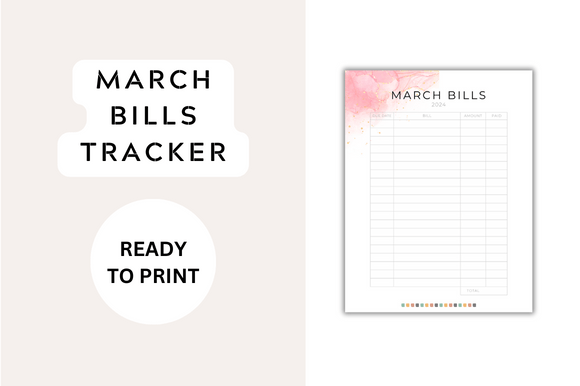
Take control of your monthly finances with a tool designed for visual clarity and practical efficiency. The March Bills Tracker Printable is more than just a document; it's a custom-crafted PDF that transforms the mundane task of bill management into a streamlined, visually coherent process. For designers, creators, and business owners, this one-pager embodies the principle that effective organization is the foundation of both financial health and professional workflow.
At its core, this tracker is a study in minimalist graphic design. Its single-page layout champions visual hierarchy, ensuring every element—from due dates to payment amounts—has a clear, purposeful place. This approach mirrors modern branding trends where simplicity and functionality drive user engagement. The clean typography and intuitive grid system make it not only easy to fill out but also a pleasure to interact with, reducing the cognitive load associated with financial planning.
Practical Applications for Creative Professionals
For those in creative fields, integrating a system like the March Bills Tracker into your routine offers surprising benefits beyond mere organization. It serves as a practical exercise in applying design principles to everyday tasks.
- Brand Consistency: Using a consistently designed tracker reinforces a personal or business brand identity, even in administrative tasks. It establishes a tone of professionalism and attention to detail.
- Digital Marketing and Content: The design can inspire social media graphics or web content focused on productivity tips, showcasing your expertise in creating functional visual solutions.
- Client Presentations: Demonstrating your use of well-designed organizational tools can subtly communicate your commitment to structured, high-quality work in client meetings and proposals.
Integrating Design Thinking into Financial Tools
The true value of a resource like the March Bills Tracker Printable lies in its alignment with core graphic design tenets. Its effectiveness is rooted in deliberate choices that any designer or marketer can appreciate.
- Typography and Readability: The selection of fonts likely prioritizes legibility, ensuring that critical information like amounts and dates are instantly scannable—a key principle in UI and UX design.
- Visual Hierarchy and Color Palette: A restrained color palette and clear section headers guide the eye naturally through the document. This mimics best practices in editorial design and web layouts, where content flow is paramount.
- Scalability and Format: As a printable PDF, it’s designed for physical use, but the note to export it as an MP4 for a video invitation hints at its adaptability. This speaks to the need for assets that can transition across print and digital media, a common requirement in modern packaging and advertising campaigns.
Maximizing Your Creative Assets
When selecting any design asset, whether for a branding project or personal productivity, consider its compatibility with your existing systems. The March Bills Tracker's one-page design is a testament to efficiency, but always evaluate such tools for:
- Consistency: Does its style harmonize with your other creative projects or your established brand identity?
- Functionality: Is the layout intuitive, allowing for quick updates without sacrificing visual appeal?
- Adaptability: Can the core design be repurposed or inspired for other needs, like social media graphics or presentation slides?
Thoughtful design choices extend beyond client work; they shape how we organize our own professional lives. Quality creative assets, like this printable tracker, do more than save time—they elevate routine tasks into opportunities for visual coherence and brand reinforcement. By applying the same principles of clarity, hierarchy, and aesthetic intention to our tools, we cultivate a workflow that is as efficient as it is visually satisfying, paving the way for incredible management in all areas of our creative endeavors.